

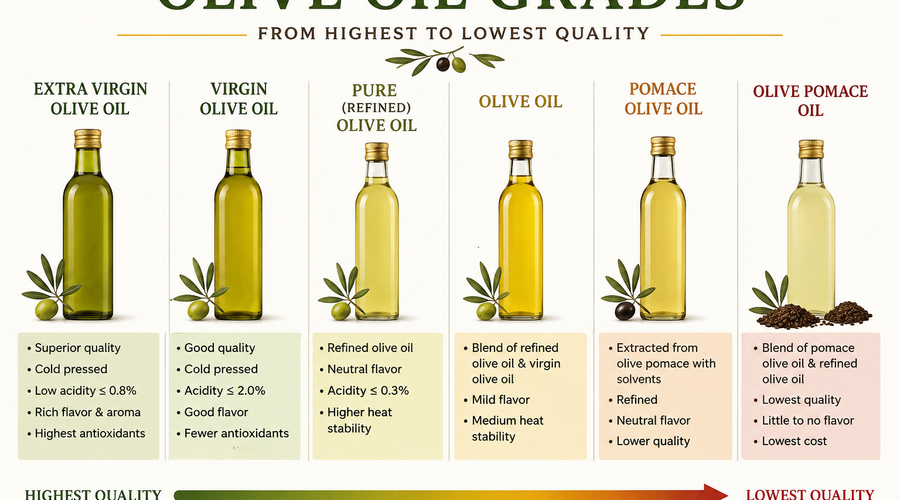
What does Ultra Premium Extra Virgin Olive Oil actually mean?
For us, it isn't simply a marketing phrase.
The Ultra Premium, or UP, standard uses objective chemical analysis to evaluate the quality, freshness, condition and composition of extra virgin olive oil.
While an olive oil must meet established requirements to qualify as extra virgin, the UP standard goes further by applying stricter limits and additional chemical measurements.
That's why you'll see actual chemistry information accompanying the EVOOs we carry at The Anointed Olive.
Here's what those numbers mean.
Free Fatty Acids (FFA)
Free Fatty Acids develop when the triacylglycerols in olive oil begin to break down.
FFA can provide important information about the condition of the olives and how they were handled before and during extraction.
Elevated FFA can indicate problems such as damaged or poor-quality fruit, excessive time between harvest and milling, improper storage or excessive temperatures during extraction.
International Olive Council Extra Virgin Limit: ≤ 0.8%
Ultra Premium Limit: ≤ 0.3%
Lower FFA is generally associated with better fruit quality and handling.
FFA is also particularly interesting when discussing cooking with EVOO, because it is one of the factors that influences an olive oil's smoke point.
Oleic Acid
Oleic acid is the predominant fatty acid in olive oil and typically accounts for approximately 55% to 85% of its fatty-acid composition.
It is a monounsaturated fatty acid and contributes significantly to olive oil's oxidative stability.
Oils with higher oleic-acid content generally have greater resistance to oxidation than oils containing larger proportions of polyunsaturated fatty acids.
International Olive Council Minimum: ≥ 55%
Ultra Premium Minimum: ≥ 65%
This is one of the reasons we pay attention to an EVOO's fatty-acid composition rather than simply looking at the words extra virgin on the bottle.
Peroxide Value
Peroxides are primary oxidation products formed when oil is exposed to oxygen.
The Peroxide Value, or PV, is therefore an important measurement of oxidation and can provide information about an oil's freshness, condition and storage history.
Higher peroxide values can indicate oxidation or poor-quality oil.
International Olive Council Limit: ≤ 20 mEq O₂/kg
Ultra Premium Limit: ≤ 9 mEq O₂/kg
In this case, lower is better.
UV Absorption — K232, K270 & Delta K
UV spectrophotometric testing provides additional information about oxidation and possible refining or adulteration.
Three measurements are particularly important:
K232 is associated primarily with early oxidation products.
K270 can indicate secondary oxidation and may also provide clues about refining.
Delta K is another measurement used when evaluating whether an oil's UV absorption profile is consistent with genuine virgin olive oil.
International Olive Council Limits
K232 ≤ 2.5
K270 ≤ 0.22
Delta K ≤ 0.01
Ultra Premium Limits
K232 ≤ 2.0
K270 ≤ 0.20
Delta K ≤ 0.01
The UP K232 and K270 limits are stricter than the general IOC extra virgin limits.
Biophenols
This is one of the chemistry numbers customers often ask us about.
The current UP standard describes this measurement as Phenolic Content (Polyphenols). At The Anointed Olive, you'll generally hear us refer to these naturally occurring compounds as Biophenols.
Biophenols are antioxidant compounds naturally present in olives and virgin olive oil.
They contribute to an EVOO's resistance to oxidation and are also associated with some of the bitterness and pungency you experience when tasting fresh olive oil.
Phenolic content naturally decreases as an oil ages, making it another useful piece of information when considering freshness and stability.
The general extra virgin standard does not establish a minimum phenolic-content requirement.
Ultra Premium Minimum: ≥ 200 ppm
That doesn't mean that the EVOO with the highest Biophenol number is automatically the “best” oil.
Olive variety, harvest timing, growing conditions and flavor all matter.
But the measurement gives us valuable information about what's actually in the oil.
DAGs
DAGs—or diacylglycerols—provide another window into an olive oil's condition and freshness.
Fresh, properly produced olive oil contains a high proportion of 1,2-diacylglycerols relative to total diacylglycerols.
As olive oil ages or degrades, that ratio changes.
Low DAG values can therefore indicate poor-quality fruit, oxidation, age or sensory defects.
Australian Olive Association Limit: ≥ 35%
Ultra Premium Limit Immediately After Production: ≥ 90%
DAGs are particularly useful because they're capable of telling us something that a simple acidity measurement cannot.
PPP
PPP stands for pyropheophytins.
As olive oil undergoes thermal degradation, chlorophyll pigments break down from pheophytins into pyropheophytins.
Measuring the percentage of pyropheophytins can therefore provide information about an oil's age and whether it may have been exposed to excessive heat.
It can also help identify oils that have undergone processes such as soft-column refining, deodorization or backblending.
Australian Olive Association Limit: ≤ 17%
Ultra Premium Limit Immediately After Production: ≤ 2%
Again, in this measurement, lower is better.
Why DAGs and PPP Are Particularly Interesting
FFA and Peroxide Value tell us important things about an oil.
But they don't tell us everything.
DAGs and PPP add additional information about freshness, degradation and possible processing.
That's important because an olive oil isn't static after it's produced.
It changes over time.
By looking at multiple measurements together, we get a much more complete picture of what's happening inside the bottle.
Why Doesn't One Number Tell the Whole Story?
Because olive oil is complicated.
An EVOO could have extremely high Biophenols but that doesn't tell you its FFA.
A very low FFA doesn't tell you its Peroxide Value.
Oleic Acid doesn't tell you whether the oil has been exposed to heat.
And none of those numbers individually tells you how the oil tastes.
That's why the UP standard evaluates a collection of chemical parameters rather than relying on one impressive number.
Extra Virgin Is the Starting Point
This distinction is probably the most important one.
Ultra Premium doesn't replace the extra virgin classification.
It builds upon it.
An oil must first meet the requirements associated with extra virgin olive oil. The UP standard then imposes additional requirements and tighter limits designed to identify exceptionally fresh, well-produced oils.
That is why two bottles can both legitimately say Extra Virgin Olive Oil while having very different chemistry.
Why We Share the Chemistry
We don't expect our customers to become olive-oil chemists.
But we do believe you should be able to know more about the olive oil you're buying than what is printed on the front of a bottle.
That's why our EVOOs include chemistry information such as:
Biophenols • FFA • Oleic Acid • Peroxide Value • DAGs • PPP
Those numbers allow us to evaluate an oil objectively—and they give you information that can't be determined from packaging, color or marketing language.
Combined with sensory evaluation and, most importantly, tasting the oil, chemistry helps tell the story of what's actually inside the bottle.
The Takeaway
Not all extra virgin olive oils are chemically identical.
The Ultra Premium standard goes beyond the general extra virgin requirements by establishing stricter limits and incorporating additional measurements designed to evaluate quality, freshness, oxidative condition and authenticity.
That's the reason we don't simply tell you that our olive oil is good.
We show you the chemistry.


Leave a comment