

“I heard you're not supposed to cook with extra virgin olive oil.”
It's one of the most persistent myths about EVOO—and one of the questions we hear regularly.
The short answer is:
Yes. You can cook with extra virgin olive oil.
You can sauté with it. Roast with it. Bake with it. And yes, you can fry with it.
The confusion usually starts with something called smoke point. But smoke point is only one part of understanding how an oil behaves when it's heated.
What Is Smoke Point?
Smoke point is the temperature at which an oil begins to produce a continuous visible smoke.
You've probably experienced it. Leave oil in a hot pan too long and eventually you'll see smoke coming from the surface.
Every cooking oil has a point at which this happens.
But here's where things get complicated:
Extra virgin olive oil doesn't have one universal smoke point.
The quality and chemistry of the individual oil matter.
FFA and the Smoke Point of EVOO
One measurement that influences an olive oil's smoke point is Free Fatty Acid, or FFA.
FFA is one of the chemistry measurements used when evaluating extra virgin olive oil.
Generally, the lower the FFA, the higher the smoke point of the oil.
That's one reason broad statements such as “olive oil has a low smoke point” can be misleading. A fresh, properly produced EVOO with very low FFA can behave quite differently from a lower-quality oil with higher FFA.
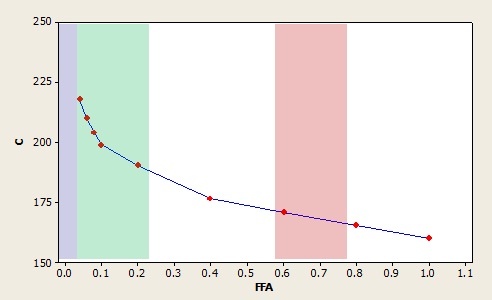
The chart illustrates just how much FFA can influence the smoke point of an extra virgin olive oil.
And this is one reason we provide the chemistry of our EVOOs rather than relying solely on the words extra virgin on a label.
But Smoke Point Isn't the Whole Story
This may be the most important part of the conversation.
When choosing an oil for cooking, smoke point isn't the only measurement that matters.
Researchers also look at an oil's oxidative stability—its resistance to breaking down through oxidation when exposed to heat and oxygen.
An oil's stability is influenced by several things, including:
Its fatty-acid composition.
Extra virgin olive oil is naturally high in oleic acid, a monounsaturated fatty acid. Monounsaturated fats are more resistant to oxidation than fats containing high amounts of polyunsaturated fatty acids.
Its natural antioxidants.
Fresh EVOO contains naturally occurring biophenols and other antioxidant compounds.
Its quality and condition.
How an oil was produced, its chemistry, age and how it has been stored can all affect its performance.
So asking only “What's its smoke point?” doesn't give you the complete picture.
What Happens to Biophenols When EVOO Is Heated?
Heat can reduce some of the naturally occurring biophenols in extra virgin olive oil.
That sometimes gets turned into another myth:
“Cooking destroys everything healthy in olive oil.”
It doesn't.
EVOO's fatty-acid composition doesn't suddenly disappear when the oil is heated. Its oleic acid and monounsaturated-fat content remain important characteristics of the oil.
And while some biophenols can be lost during cooking, research has shown that EVOO can retain phenolic compounds after cooking, with the amount retained depending on factors such as temperature, cooking time and the oil itself.
Researchers have also found something particularly interesting when EVOO is used to cook food: some of its phenolic compounds can transfer into the food being cooked.
So the story isn't simply “heat destroys the good stuff.”
Why Oxidation Matters
When oils are heated, particularly for extended periods or repeatedly, they undergo oxidation and can form undesirable breakdown products.
That's true of all cooking oils.
The question is how resistant an oil is to that process.
EVOO has two important things working in its favor:
Its high proportion of monounsaturated oleic acid gives it greater resistance to oxidation than oils containing larger amounts of polyunsaturated fatty acids.
And fresh EVOO contains naturally occurring antioxidants that provide additional protection against oxidation.
This combination helps explain why extra virgin olive oil has performed well in studies examining cooking-oil stability.
Can You Fry with Extra Virgin Olive Oil?
Yes.
Frying temperatures commonly fall within the range that a good-quality EVOO can handle.
As with any cooking oil, you don't want to heat it until it's smoking excessively or allow it to burn.
And repeated, prolonged heating will eventually degrade any oil.
But there's no scientific basis for the blanket statement that extra virgin olive oil shouldn't be used for frying simply because it's EVOO.
What About Sautéing and Roasting?
Absolutely.
Extra virgin olive oil is well suited to everyday cooking methods such as:
- Sautéing
- Roasting
- Baking
- Grilling
- Pan cooking
- Frying
For most home cooking, the bigger concern isn't whether EVOO can handle the heat.
It's whether you're overheating the pan and burning your food.
Does the EVOO You Choose Matter?
Yes—and this is where understanding olive-oil chemistry becomes particularly useful.
When we evaluate our extra virgin olive oils, we don't look at one number.
We provide measurements including FFA, Oleic Acid, Biophenols, Peroxide Value, DAGs and PPP because together they tell us much more about an oil than a generic smoke-point number ever could.
FFA is particularly relevant to smoke point.
Oleic acid contributes to the oil's fatty-acid composition and stability.
Biophenols contribute antioxidant protection.
And the other chemistry measurements help us understand the oil's quality, condition and freshness.
The oil in the bottle matters.
What About Flavor?
There's another reason to think about which EVOO you use for cooking, and this one has nothing to do with safety.
Flavor.
Heating can diminish some of the delicate aromas and flavors that make a particular EVOO special.
That doesn't mean the oil has become unhealthy.
It simply means you may not want to use your most beautifully complex EVOO in an application where you won't be able to appreciate those characteristics.
Sometimes you'll want a robust EVOO that contributes flavor during cooking.
Other times you'll choose a delicate EVOO.
And sometimes you'll save a particularly interesting oil for finishing a dish where you can really taste it.
That's a culinary decision—not a safety issue.
Watch: Understanding Olive Oil & Smoke Point
[KEEP EXISTING SMOKE-POINT VIDEO HERE]
Smoke point is much easier to understand when you can see how olive-oil quality and FFA affect it. Our smoke-point video walks through the concept and helps explain why the blanket statement that EVOO has a “low smoke point” simply doesn't tell the whole story.
The Takeaway
Yes, you can cook with extra virgin olive oil.
Smoke point matters, but it isn't the only thing that determines whether an oil is appropriate for cooking.
With EVOO, we also have to consider FFA, fatty-acid composition, biophenols, oxidative stability, freshness and overall quality.
A fresh, well-made extra virgin olive oil with low FFA can have a smoke point suitable for everyday cooking, while its naturally high oleic acid content and antioxidant compounds contribute to its stability when heated.
So sauté with it.
Roast with it.
Bake with it.
Fry with it.
And the next time someone tells you that you can't cook with extra virgin olive oil because of its smoke point, you'll know there's a lot more to the story.


Leave a comment